
Technical guide
Cleanroom Mop Materials: Polyester vs Microfiber vs Polyester-Cellulose
How to compare cleanroom mop constructions without assuming that one material wins every workflow.
By Jing Jiang · Published · Updated
Direct answer
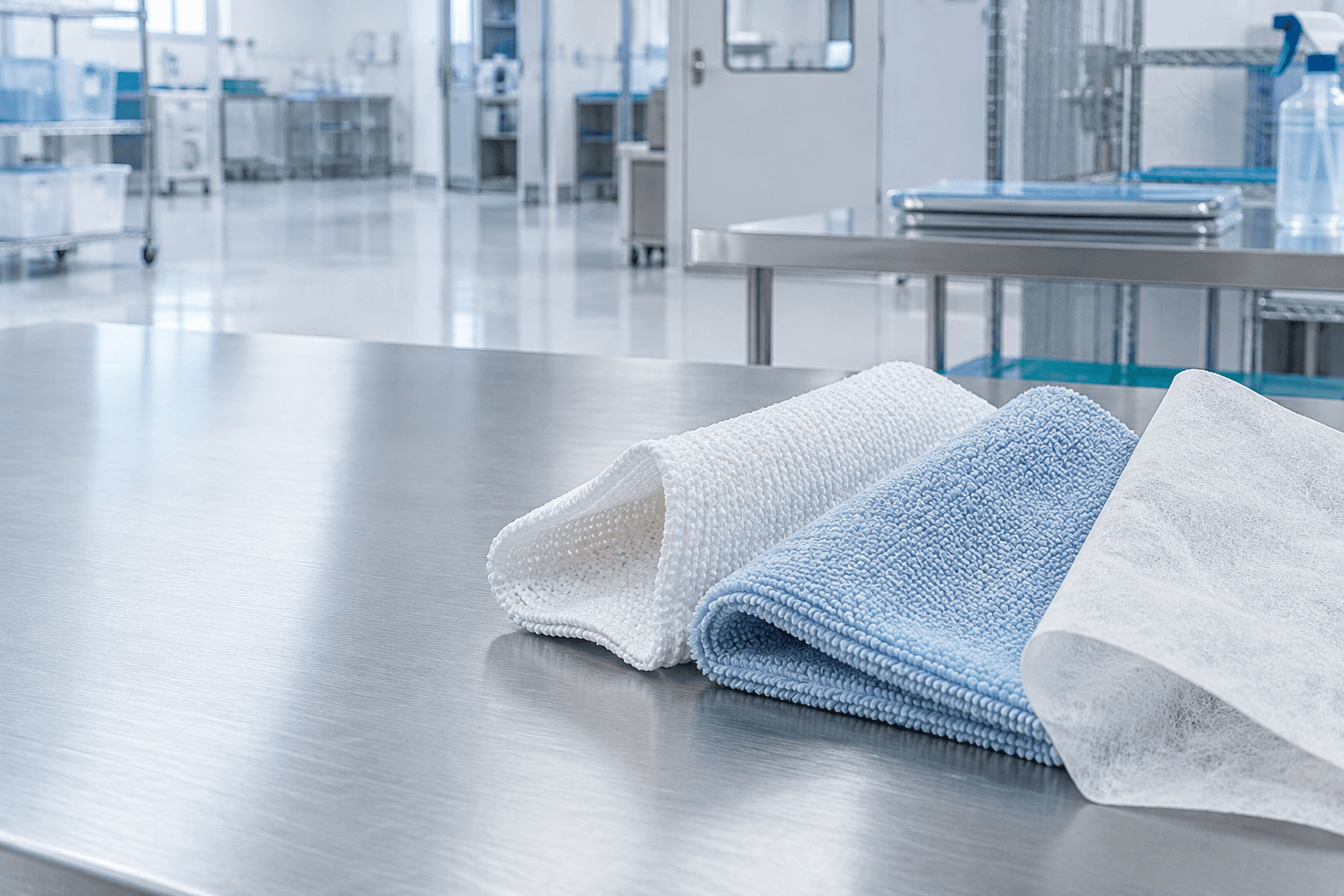
There is no universal best cleanroom-mop material. Polyester, microfiber and polyester-cellulose should be compared as complete constructions under the same surface, solution and route—not by fibre name or one headline absorbency percentage.
Technical review
Start with construction, not the fibre label
The finished result depends on yarn or fibre geometry, knit or loop structure, mass, pore volume, backing, edge treatment, seams and any finishing process. Two products that both say ‘polyester’ can handle liquid and release solution differently; the same is true for microfiber and blended nonwovens.
For procurement, record the exact construction and part number. A material family is useful for narrowing the search, but it is not enough to support a performance or application claim.
- Fibre or yarn construction
- Nominal mass and dimensions
- Knit, loop, pile or nonwoven structure
- Backing, edge and attachment details
- Packaging and sterile presentation
Technical review
Use a same-condition comparison
Compare candidate mops with the same solution, surface, wet load, conditioning method, frame and cleaning route. Record pickup, retention, release, coverage consistency and visible residue. If particle or lint risk matters, use the site’s approved test method rather than an unscoped supplier number.
This turns ‘which material is better?’ into a decision that QA and operations can review. It also prevents a result from one construction being copied to a different weight, size or backing.
- Pickup and retention
- Release and coverage consistency
- Particle or lint evidence
- Chemical exposure review
- Frame fit and operator handling
Technical review
Make claims configuration-specific
A defensible comparison names the SKU, test method and conditions. The current evidence library confirms selected Polyester Knit Mop configurations and nominal fields, but it does not establish a universal performance ranking against microfiber or polyester-cellulose. Keep any untested comparison open for sample evaluation.
- Confirmed: material and configuration identity
- Needs confirmation: relative performance, coverage and compatibility
- Next step: test the exact candidates in the intended workflow
Evidence library
Confirmed data and open questions
The table below is limited to MIDPOSI Polyester Knit Mop records in the evidence library. It is SKU-scoped and reviewed against the MIDPOSI Polyester Knit Mop Variant Specifications record dated 2026-08-31. It is not a universal claim for other mop families.
| Field | MID-MOP-PK-40G-N | MID-MOP-PK-40G-S | MID-MOP-PK-55G-N | MID-MOP-PK-55G-S | MID-MOP-PK-65G-N | MID-MOP-PK-65G-S |
|---|---|---|---|---|---|---|
| SKU | MID-MOP-PK-40G-N | MID-MOP-PK-40G-S | MID-MOP-PK-55G-N | MID-MOP-PK-55G-S | MID-MOP-PK-65G-N | MID-MOP-PK-65G-S |
| Sterile status | Non-Sterile | Sterile | Non-Sterile | Sterile | Non-Sterile | Sterile |
| Nominal size | 40 cm × 12 cm | 40 cm × 12 cm | 40 cm × 12 cm | 40 cm × 12 cm | 40 cm × 12 cm | 40 cm × 12 cm |
| Nominal weight | 40 g (±10%) | 40 g (±10%) | 55 g (±10%) | 55 g (±10%) | 65 g (±10%) | 65 g (±10%) |
| Construction | 4-layer, 100% polyester knit | 4-layer, 100% polyester knit | 5-layer, 100% polyester knit | 5-layer, 100% polyester knit | 5-layer polyester construction | 5-layer, 100% polyester knit |
| Packaging / sterilization | Needs further confirmation | Double-layer vacuum sealed; gamma irradiated; carton quantity: 100 | Needs further confirmation | Double-layer vacuum sealed; gamma irradiated; carton quantity: 100 | Needs further confirmation | Double-layer vacuum sealed; gamma irradiated; carton quantity: 100 |
Confirmed data
SKU identity, sterile status, nominal size, nominal weight and construction are confirmed for the six listed records. Sterile rows also carry the recorded double-layer vacuum-sealed and gamma-irradiated packaging statement.
Needs further confirmation
- • Frame interface / compatibility
- • Application and Grade A/B/C/D suitability
- • Absorbency and surface coverage
- • Particle and lint performance
- • MOQ, lead time and customization
- • Storage, expiry and reusable lifecycle data
Performance
Continue this technical review
Buyer decision factors
What to review
- 01
Exact material and finished construction
- 02
Textile mass, geometry and backing
- 03
Pickup, retention, release and coverage consistency
- 04
Particle or lint evidence
- 05
Chemical exposure and frame fit
Reference framework
Official standards and guidance
- ISO 14644-1:2015 — Classification of air cleanliness by particle concentration ↗
- EU GMP Annex 1 — Manufacture of Sterile Medicinal Products ↗
- IEST-RP-CC018 — Cleanroom Cleaning and Sanitization ↗
These sources provide the evaluation framework. Final suitability remains subject to the buyer’s SOP, risk assessment, qualification and validation process.